5 mistakes stores make when implementing conversational AI
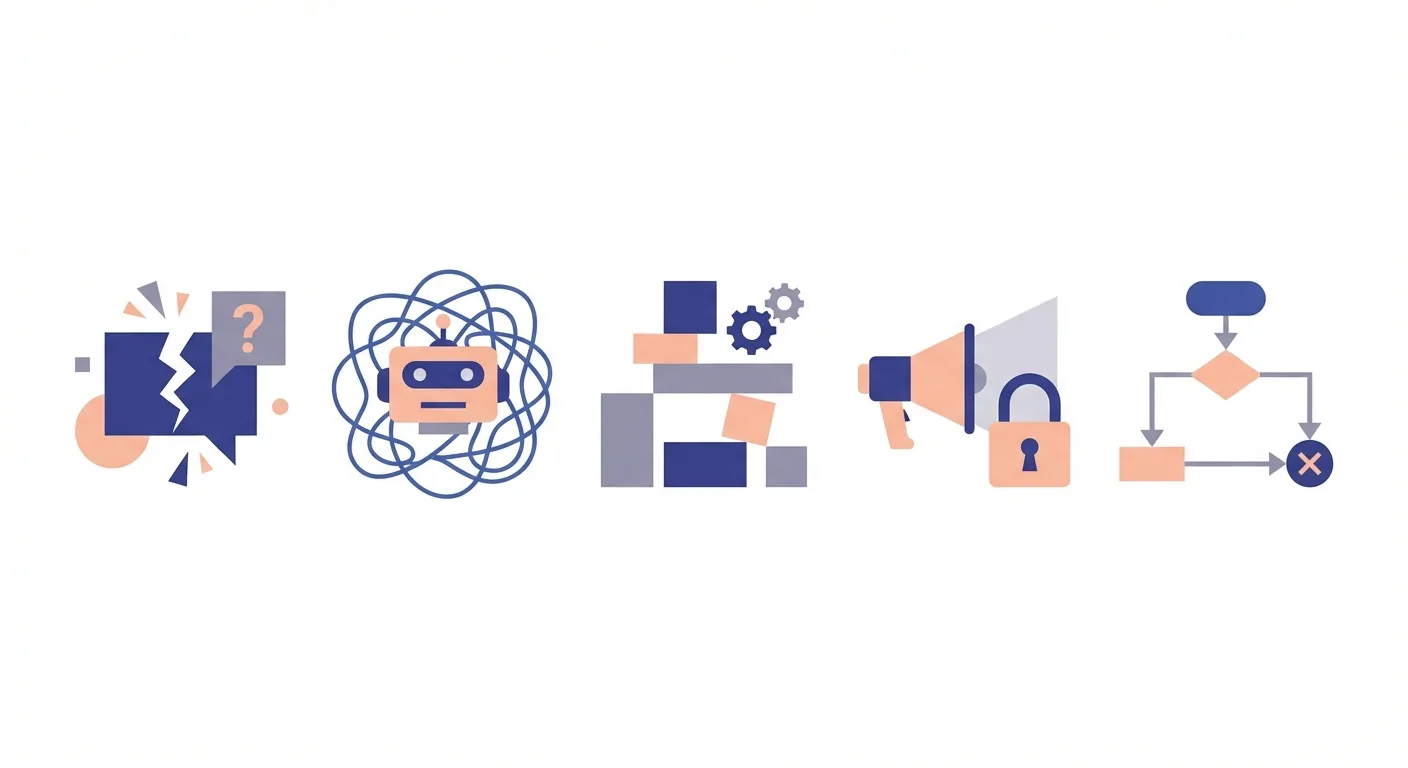
Conversational AI can transform your e-commerce. Or it can destroy your customers' experience. The difference is in the implementation.
After watching hundreds of stores try, these are the 5 mistakes that repeat over and over — and how to avoid them.
Mistake #1: Trying to automate 100%
It's tempting. "Let's automate everything and eliminate the support team." Sounds efficient. In practice, it's a disaster.
Some conversations require empathy, judgment, flexibility. A customer asking for a legitimate exception. Someone having a bad day who needs to feel heard. A case that doesn't fit any predefined rule.
Forcing AI to handle 100% means the hardest, most important 20% gets handled poorly. And that 20% is what determines whether a customer comes back or leaves forever.
AI doesn't replace humans. It frees humans to do what only humans can do.
✅ The fix
Design for 80/20 from day one. Automate FAQs, tracking, catalog queries. And build smooth escalation for the rest. Your human team should handle fewer tickets, but more important ones.
Mistake #2: Not training with real data
Most stores implement a chatbot with "example data" or their FAQ as the knowledge base. That produces generic responses that don't reflect how your customers actually talk.
A FAQ says: "For returns, please contact us within 30 business days with your proof of purchase."
A customer says: "Hey the pants came too small and I lost the receipt, can I exchange them or not?"
If your AI only understands the first version, it'll fail with the second — which is the one that happens in real life 90% of the time.
✅ The fix
Train your AI on real conversations from your support team. The last 6 months of WhatsApp chats are worth more than any FAQ written by marketing. VENDAQ uses your real data (with your permission) to create an agent that speaks like your brand actually speaks.
Mistake #3: Ignoring voice messages
We've said it before and we'll say it again: 70%+ of messages in WhatsApp across Latin America are voice notes. If your chatbot responds "I can't process voice messages, please type your query," you're rejecting the majority of your customers.
It's like putting a "cash only" sign up in 2026. Technically works, but you're losing 70% of buyers.
✅ The fix
Implement voice transcription from day one. Not as a nice-to-have. As a must-have. If your AI provider doesn't support voice, switch providers. It's that simple.
Mistake #4: No escalation plan
Surprisingly common. The store implements the chatbot, it works fine 80% of the time, and when it fails... nothing. The bot apologizes, repeats the same answer, or just loops.
Having no escalation is like having a restaurant where the waiter can't call the chef. When the question gets complicated, there's nobody to turn to.
✅ The fix
Define before launching: what happens when the AI can't resolve? Who gets notified? How is context transferred? What's the maximum wait time? These questions need answers before the first message, not after the first disaster.
Mistake #5: Measuring the wrong metrics
The most insidious mistake. The store implements AI, measures "messages answered" and "response time," sees nice numbers, and concludes everything works.
But "responding fast" isn't the same as "resolving well." A bot that responds in 2 seconds with a useless answer has excellent speed metrics and terrible outcome metrics.
What most people measure:
- First response time ✓ (useful but insufficient)
- Messages processed ✓ (pure vanity)
- Uptime ✓ (basic, not a success metric)
What you should measure:
- True resolution rate: % of conversations where the customer got what they needed.
- Post-conversation conversion: Did the chat lead to a purchase?
- AI conversation CSAT: Was the customer satisfied with the automated interaction?
- Mid-conversation abandonment rate: How many customers leave mid-chat?
- Re-contact rate: Did the customer have to write again about the same issue? That means it wasn't resolved.
✅ The fix
Define your success metrics before implementing. Not after. And make sure they reflect business outcomes, not vanity metrics. A chatbot that responds fast but doesn't sell or resolve is a cost, not an investment.
What you measure is what you optimize. Measure the wrong thing and you'll optimize the wrong thing.
The meta-mistake: implementing without strategy
All 5 mistakes above have something in common: they come from implementing conversational AI as if it were installing an app. "Turn it on and let it work."
Conversational AI isn't plug and play. It's a strategy that requires:
- Real data from your current conversations.
- Clear rules for what to automate and what not to.
- Designed escalation from day one.
- Voice support as a core feature.
- Outcome metrics defined before launch.
Do it right and you'll have an agent that sells, resolves, and scales without friction. Do it wrong and you'll have a chatbot that frustrates customers and costs you money.
The difference isn't the technology. It's the implementation.
Ready to change how your customers talk to you?
15 minutes. No strings attached.
Schedule a conversation →