Chatbot vs conversational agent: not the same thing
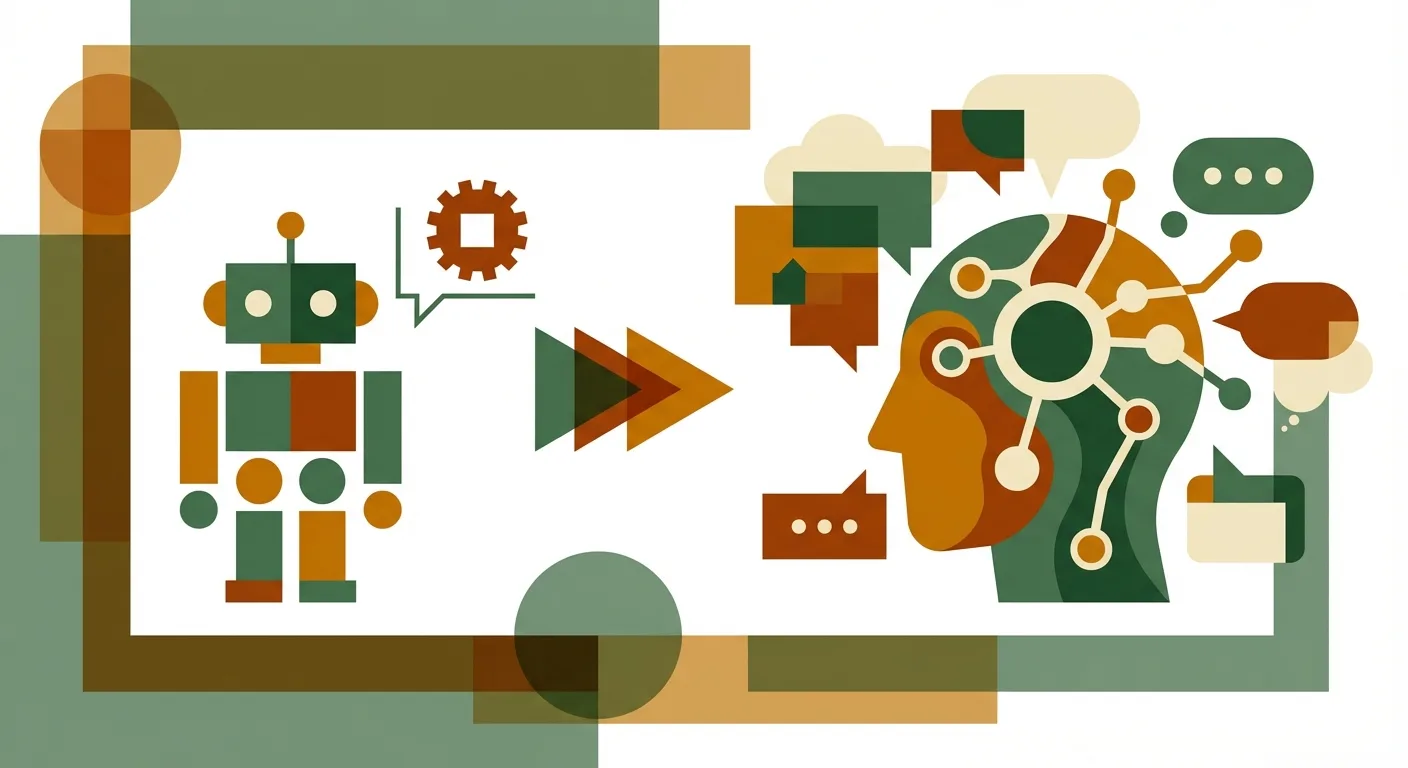
The industry uses "chatbot" and "conversational agent" as if they were synonyms. They're not. The difference between the two is like the difference between a voice recorder and a human who speaks.
One plays back predefined responses. The other understands, reasons, and adapts. Choosing the wrong one will cost you money, customers, and patience.
What a chatbot actually is
A traditional chatbot is a program that follows a decision tree. It works with keywords, buttons, and predefined flows. When you say "shipping," it looks for the keyword and gives you the associated answer. When you say "return," same thing.
It's like a phone menu converted to text. "Press 1 for shipping inquiries. Press 2 for returns. Press 3 to speak with an agent."
How it works technically
- Keyword detection: Looks for "shipping," "price," "return" in your message.
- Predefined flows: Each keyword triggers a flow with fixed responses.
- Option buttons: Presents options to navigate the decision tree.
- No memory: Each message is independent. It doesn't remember what you said before.
- Generic fallback: If it doesn't detect the keyword: "I didn't understand. Can you rephrase?"
When a chatbot is enough
To be fair, there are cases where a basic chatbot works well:
- Simple FAQs with fewer than 20 questions.
- Lead capture forms (name, email, need).
- Basic routing ("Sales or support?").
- Businesses with very low query volume (fewer than 10 per day).
If your use case is simple, static, and low-volume, a chatbot can work. But if you sell online and have more than 20 daily queries, you're going to need something more.
What a conversational agent is
A conversational agent is an AI system that understands natural language, maintains context throughout the conversation, queries data sources in real time, and makes decisions about how to respond.
It doesn't look for keywords. It understands the intent behind your words.
"Hey, I bought some sneakers last week but they're too small, what do I do?"
A chatbot would look for "sneakers" and show you the sneaker catalog. A conversational agent understands you want to exchange sizes, checks your purchase history, verifies the return policy, and guides you step by step through the process.
How it works technically
- NLU (Natural Language Understanding): Understands intent and entities in your message, regardless of how you phrase it.
- Contextual memory: Remembers the entire conversation. "And in what color?" makes sense because it knows you're talking about sneakers.
- Data integration: Queries your catalog, stock, policies, customer history — in real time.
- Reasoning: Decides what information to give, in what order, and when to escalate to a human.
- Voice: Can understand and respond with voice notes.
- Smart escalation: Knows when it needs a human and transfers with full context.
Head-to-head comparison
| Feature | Chatbot | Conversational Agent |
|---|---|---|
| Comprehension | Keywords | Full natural language |
| Memory | No memory between messages | Full conversation context |
| Data | Static responses | Real-time queries |
| Personalization | Same response for everyone | Adapts per customer |
| Voice | No | Understands and generates audio |
| Errors | Gets stuck, asks to rephrase | Asks for clarification naturally |
| Escalation | Transfers without context | Transfers with full history |
| Learning | Manual (update flows) | Improves with each conversation |
| Implementation | Days to weeks | 24-48 hours |
| Maintenance | High (update flows) | Low (self-adjusting) |
The real problem: customer expectations
Customers in 2026 don't have patience to navigate button menus. They've talked to ChatGPT. They've used voice assistants. They know what AI can do. And when your chatbot tells them "I didn't understand your question. Please select an option," they get frustrated and leave.
87% of users report frustration with chatbots that don't understand their questions. That's not a minor stat — it's the vast majority of your customers telling you your chatbot pushes them away instead of helping them.
Your customers have already talked to ChatGPT. They know what AI can do. Your button-based chatbot frustrates them.
The hidden cost of a chatbot
Chatbots seem cheap. $30-50 per month for a basic solution. But the real cost includes:
- Setup time: Designing flows, writing responses, mapping keywords. Weeks of work.
- Constant maintenance: Every new product, every policy change, every promotion requires manually updating flows.
- Frustrated customers: Every failed chatbot interaction is a potentially lost customer. What's that worth?
- Team burden: The chatbot doesn't resolve, so customers ask to talk to a human. Your team ends up answering the same questions the chatbot should handle.
- Abandonment: 60% of chatbots are abandoned within the first year because they don't meet expectations.
When you need a conversational agent
If you identify with 3 or more of these points, a chatbot isn't enough:
- You receive more than 30 daily queries.
- You sell products with variants (sizes, colors, models).
- Your customers ask in unpredictable ways.
- You need 24/7 availability.
- You want to recover abandoned carts through conversation.
- You serve customers on WhatsApp or Instagram (where there are no buttons).
- Your customers send voice notes.
- You have returning customers who expect to be recognized.
VENDAQ: an agent, not a chatbot
VENDAQ is a conversational agent. It doesn't have predefined flows. It doesn't use buttons. It doesn't look for keywords. It understands what the customer says, queries your data, and responds like your best salesperson would — just 24/7 and in 15 seconds.
We didn't write this to sell you something. We wrote it because the confusion between chatbot and agent costs e-commerce businesses money every day. They implement a chatbot thinking it's AI, get frustrated when it doesn't work, and conclude that "AI doesn't work for my business."
AI does work. What doesn't work is a phone menu disguised as a chat.
Ready to change how your customers talk to you?
15 minutes. No strings attached.
Schedule a conversation →