The midnight effect: why 35% of queries arrive after 10pm
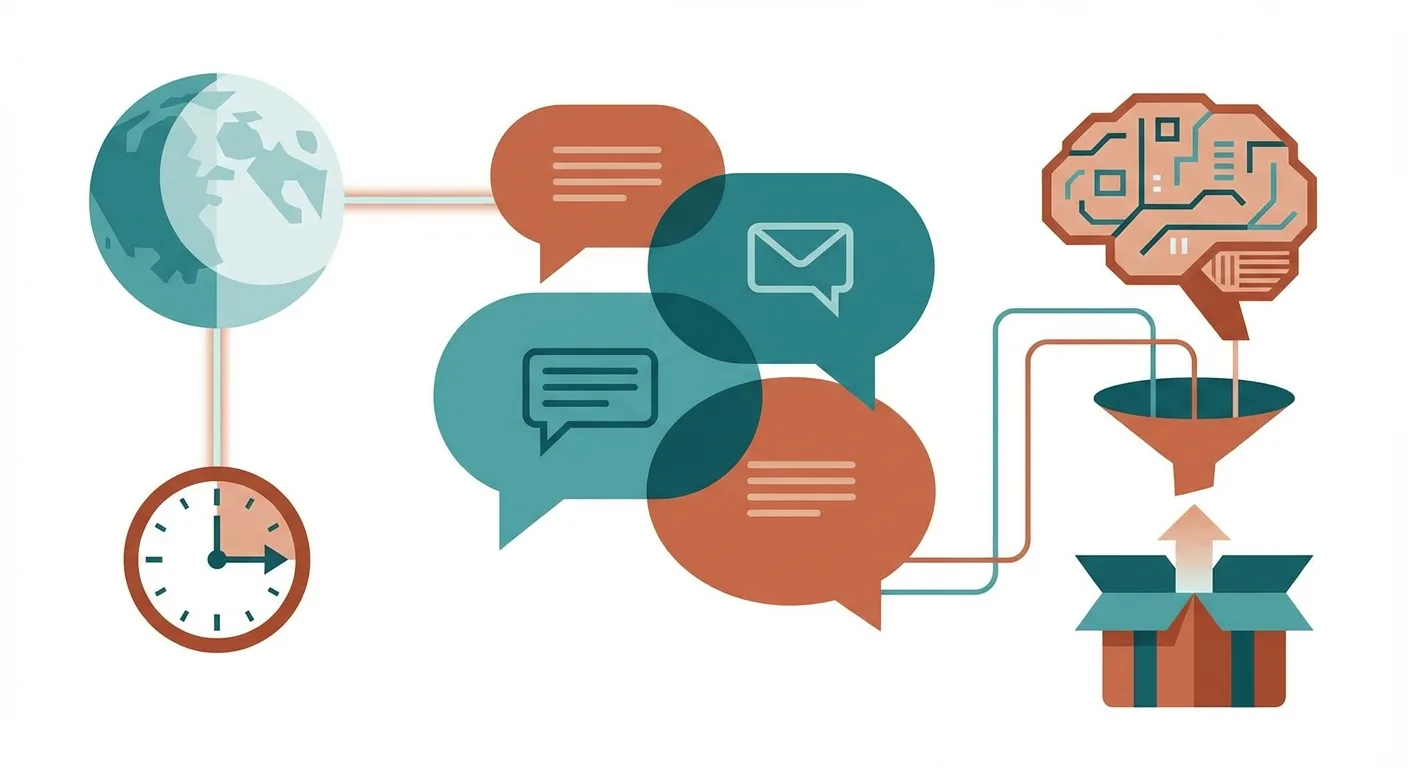
It's 11:47pm. Your customer is in bed, phone in hand, browsing your store. They found the perfect product. They have a question about sizing. They message you.
Nobody responds.
At 8am the next day, when your team opens the chat, that customer already bought from another store. Or simply forgot. The sale vanished while you slept.
Shopping hours don't match support hours
This is one of the biggest mismatches in modern e-commerce: people shop at night, but businesses operate during the day.
Google Analytics data consistently shows that e-commerce traffic has two peaks: one between 12pm-2pm (lunch break) and another between 9pm-12am (after dinner). The nighttime peak is, in most categories, the highest.
Why? Because it's the only time of day people have uninterrupted free time. Kids are asleep. Work is over. No meetings, no obligations. Just the person, their phone, and your catalog.
"The best time to sell is when the customer wants to buy. Not when you want to work."
The anatomy of a nighttime query
Queries that arrive after 10pm have a specific profile. They're not complaints. They're not grievances. They're purchase questions:
- "Do you have [product] in stock?" — They're ready to buy but want to confirm before entering payment info.
- "How long does shipping take to [city]?" — They need to know if it'll arrive in time for an event, birthday, or just out of anxiety.
- "What size do you recommend if I wear M in [other brand]?" — They don't want to risk a return.
- "Is this product compatible with [other product]?" — Technical question the product page didn't answer.
- "Can I pay in installments?" — They want to buy but need to confirm the payment option.
None of these questions are hard to answer. They're all in your knowledge base. But at 11pm, there's nobody to answer them.
80% of nighttime queries are pre-purchase questions. Not complaints. Not grievances. These are people ready to buy who just need an answer.
The cost of not responding at night
Let's do the math. If you receive 100 daily queries and 35% arrive after 10pm, that's 35 nighttime queries. If 80% have purchase intent (28 queries) and your conversion rate with fast response is 25%, you're losing 7 sales per night.
With an average ticket of $50, that's $350 per day. $10,500 per month. $126,000 per year.
For sleeping.
Solutions that don't work
Night shift
Hiring someone for the night shift sounds logical. In practice: it's expensive (nighttime labor carries premiums), turnover is extremely high (nobody wants to work nights permanently), and quality drops (a tired person at 2am isn't at their best).
Generic auto-replies
"Thanks for your message! We'll get back to you tomorrow during business hours." Congratulations, you just told your customer their money doesn't matter after 6pm. The probability they'll wait until tomorrow is under 20%.
Flow-based chatbot
A basic chatbot with buttons and predefined flows can handle the 3-4 most common questions. But if the question falls outside the flow — and most do — the chatbot freezes. "I didn't understand your question. Can you select an option?" Frustration. Abandonment.
What actually works: 24/7 conversational AI
A conversational AI agent doesn't have a schedule. It doesn't get sleepy. It doesn't get cranky at 3am. And most importantly: it knows what you sell.
When a customer writes at 11:47pm asking about shoe sizing, the AI:
- Checks your catalog in real time.
- Gives the sizing recommendation based on the measurement chart.
- Sends a direct purchase link.
- Offers help with any other questions.
All in 15 seconds. At 11:47pm on a Tuesday. Without anyone on your team waking up.
What about complex issues?
If the query requires human intervention — a serious complaint, a special situation, something the AI can't resolve — the AI doesn't ignore it or give a made-up answer. It creates a card in Link with all the information, tells the customer a specialist will contact them first thing in the morning, and your team sees it as a priority when they arrive.
The customer feels attended to. The query isn't lost. And your team has all the context to resolve quickly.
Late-night shopping data across markets
The midnight effect is pronounced across different markets for various cultural reasons:
- Latin America: Peak shopping between 10pm-1am. Late dinner cultures push browsing later.
- Southern Europe: Peak between 9pm-12am. Similar late-night culture.
- North America: Peak between 8pm-11pm. Couch commerce after dinner.
- Southeast Asia: Peak between 9pm-12am. High mobile usage before bed.
In every case, the window of highest commercial activity coincides with the window of lowest customer support. It's a systemic problem.
Implementing nighttime support with VENDAQ
You don't need a special plan for nighttime. VENDAQ works the same at 3pm as at 3am. The AI:
- Answers product, shipping, sizing, stock, and payment queries.
- Sends direct purchase links.
- Processes purchase intent and facilitates closing.
- Escalates to humans when needed, with full context.
- Generates nighttime activity reports so you understand what your customers ask at night.
Clients who implement VENDAQ report that 30-40% of their AI-assisted sales happen outside business hours. Sales that simply didn't exist before.
Your store doesn't sleep. Your support shouldn't either.
E-commerce doesn't have closing hours. Your catalog is available 24 hours. Your payment gateway works at midnight. Your logistics can process orders at 2am.
Why is your customer support the only thing that closes at 6pm?
The midnight effect isn't a curious phenomenon. It's money you leave on the table every night. And the solution isn't more people working at night. It's technology that doesn't need to sleep.
Ready to change how your customers talk to you?
15 minutes. No strings attached.
Schedule a conversation →