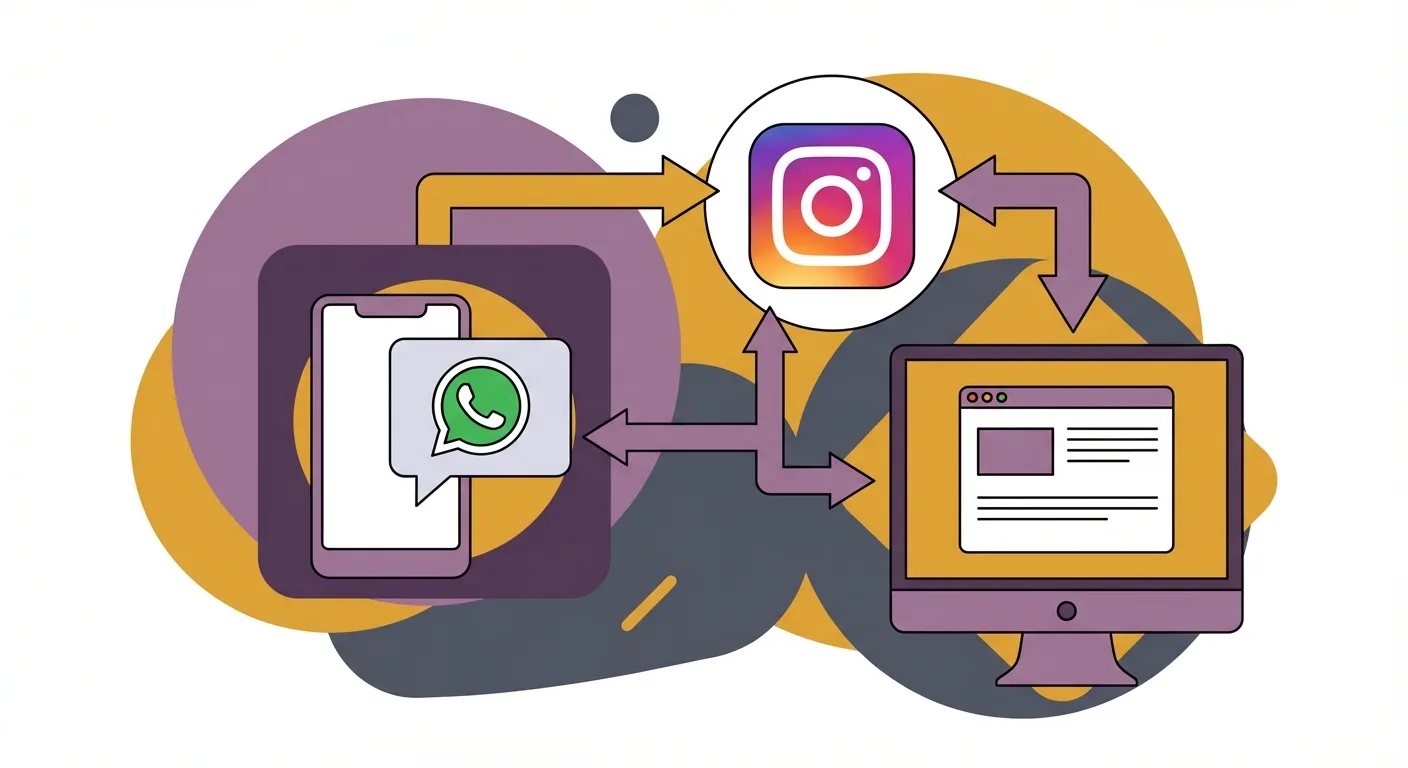
Your store has WhatsApp, Instagram DM, web chat, maybe Facebook Messenger. Each channel with its own inbox, notifications, and logic. Your team jumps from tab to tab like a ping pong player.
That's not multichannel support. It's multichannel chaos.
The problem: three channels, three parallel worlds
The typical scenario: a customer asks on Instagram DM if you have a product. Doesn't get a fast reply. Writes on WhatsApp. A different person responds. Has to start over. Gets frustrated.
Or worse: buys via web chat, has a problem, and writes on WhatsApp. The WhatsApp agent has no idea they already bought, what they bought, or what they were already told on another channel.
Your customers don't think in "channels." They think in "your brand." And they expect your brand to remember them — regardless of where they write.
Why multichannel fails
The root of the problem is simple: each channel is a silo. Instagram doesn't talk to WhatsApp. WhatsApp doesn't talk to your web chat. Your CRM (if you have one) has partial data from each.
The concrete problems:
- Lost context. What the customer said on Instagram doesn't exist on WhatsApp.
- Duplicate responses. Two agents respond to the same customer through different channels.
- Fragmented metrics. You can't measure the complete customer experience, only fragments per channel.
- Impossible prioritization. Is the urgent message on WhatsApp or the web chat? Have to check both.
- Team burnout. Switching between 3 platforms all day is exhausting and error-prone.
The "one brain, many mouths" approach
The solution isn't having a team per channel. It's having one agent that lives across all channels.
Imagine a central brain that:
- Receives messages from WhatsApp, Instagram, web chat, and any other channel.
- Identifies the customer even when they write from different channels.
- Has the complete history of all interactions, regardless of channel.
- Responds with the same knowledge, tone, and context everywhere.
The customer writes wherever they want. The agent knows who they are, what they've ordered before, and what conversation they had yesterday — even if it was on another channel.
One brain, many mouths. That's the difference between multichannel and omnichannel.
Unified conversation history
This is the most underrated and most transformative feature. When a customer writes you on WhatsApp, you can see:
- That yesterday they asked on Instagram DM about a product.
- That last week they bought through the web chat.
- That their order had a delay that was already resolved.
- That their general tone is informal and they use lots of emojis.
With that information, the first response is already relevant, personalized, and contextual. No asking "how can I help you?" as if it's the first time.
How to prioritize channels
Not all channels are equal. Prioritize by urgency and intent:
High priority
- WhatsApp: Customers expect a reply in minutes. It's the most personal channel and has the highest purchase intent.
- Live web chat: The customer is on your site, probably about to buy. Every second of wait time is lost conversion.
Medium priority
- Instagram DM: Mix of product inquiries and casual messages. Important but less urgent.
- Facebook Messenger: Low volume but customers who use it tend to be older and expect a human response.
Flexible priority
- Email: Customers who email already expect a slower response. Prioritize by content, not arrival order.
With VENDAQ, prioritization is automatic. The system analyzes the channel, message content, sentiment, and customer history to determine which conversation needs attention first.
Step-by-step implementation
- Audit your current channels. Which do you use? Which has the most volume? Which converts best? Data will tell you where to focus first.
- Unify on one platform. All channels need to converge in one place. Not three inboxes — one.
- Implement cross-channel identification. The same customer who writes on Instagram and WhatsApp should have one profile, not two.
- Set up prioritization rules. Not everything gets equal treatment. A complaint on WhatsApp is more urgent than a general inquiry via email.
- Activate an omnichannel AI agent. An agent like VENDAQ that lives across all channels, with the same brain and the same context.
- Measure holistically. Not metrics per channel. Metrics per customer. How many total interactions did Maria have before buying? Across how many channels?
True multichannel metrics
If your cross-channel rate is high, it's not your customers' problem. It's your response time problem on the original channel.
What changes for your team
Well-implemented multichannel support doesn't mean more work. It means smarter work:
- One inbox. Not 3 tabs, not 3 apps, not 3 logins.
- Automatic context. Every conversation arrives with full history.
- Smart prioritization. Urgent conversations rise, less urgent ones wait.
- Fewer errors. No duplicates, no lost context, no contradictory responses.
Your team stops being operators of 3 tools and becomes what they should be: problem-solving experts.
The future is omnichannel or nothing
In 2026, having "multichannel presence" isn't enough. Your customers expect an omnichannel experience — where it doesn't matter how they contact you, the experience is consistent, contextual, and seamless.
You don't need more channels. You need a better brain behind them.
Ready to change how your customers talk to you?
15 minutes. No strings attached.
Schedule a conversation →