40% abandon after a transfer. Here's how we fixed it.
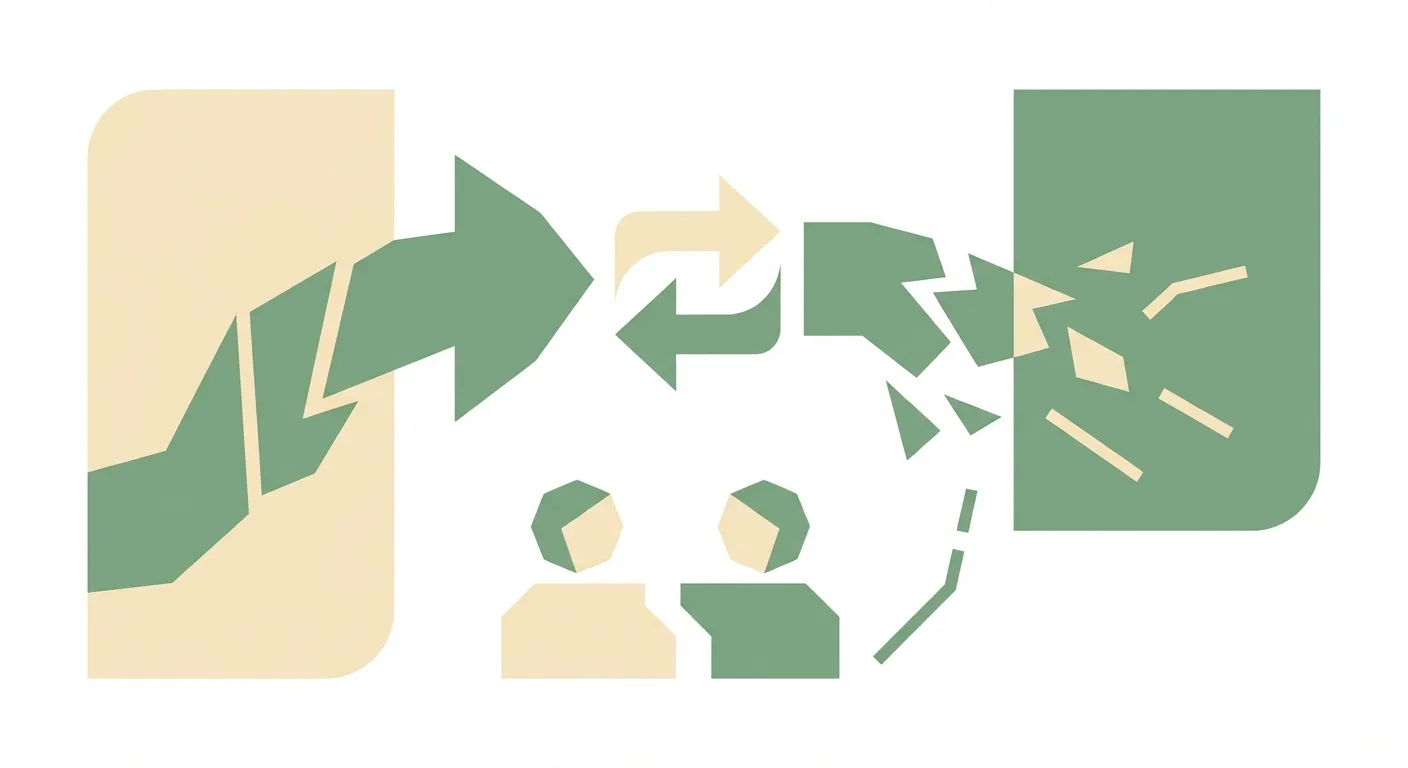
There's an exact moment when you lose the customer. It's not when your product is out of stock. It's not when the price is too high. It's when your chatbot says:
"I can't help with that. Let me transfer you to a human agent."
In that instant, 40% of your customers leave. They don't wait. They don't "hold the line." They leave.
The anatomy of a transfer
To understand why it hurts so much, let's break down what the customer experiences:
- Wasted time investment. They already explained their problem. Already sent photos. Already answered questions. Now they have to start over.
- Broken trust. The chatbot promised to help. It couldn't. Now the customer distrusts the next interlocutor too.
- Uncertain wait. "Your position in queue: 7." How long is that? 5 minutes? 45? Nobody knows?
- Context switch. The customer was doing something else — cooking, driving, on the subway. The transfer demands they stay there, attentive, waiting.
Multiply that by every interaction, every day, every month. This isn't a minor issue. It's a hemorrhage.
The data
These numbers come from Zendesk, Salesforce studies, and our own research. They're not projections — they're measured reality.
The model everyone uses (and why it fails)
The standard automated support model works like this:
Bot tries → Bot fails → Transfer → Human takes over → Customer repeats everything
It's linear. It's sequential. And it has a catastrophic breaking point: the transfer. The moment where context is lost, trust breaks, and patience runs out.
Most companies try to fix this by making the bot "smarter." More flows. More conditions. More training. But the problem isn't the bot's intelligence — it's the architecture.
Inverting the model: invisible escalation
At VENDAQ, we completely inverted the logic:
AI agent leads → Needs input → Consults team in background → Team responds → Agent continues → Customer never knows
There's no transfer. No queue. No "let me connect you with an agent." The customer keeps talking to the same entity, in the same conversation, without interruptions.
How it works in practice
Example: a customer asks if you can do express shipping to Antofagasta to arrive by Friday.
Old model:
- Bot: "I don't have that information. Transferring you."
- Queue wait: 12 minutes.
- Human agent: "Hi, how can I help?"
- Customer: (repeats everything)
- Result: 40% chance they already left.
VENDAQ model:
- Agent: "Great question. Let me check — need anything else in the meantime?"
- Your team gets via WhatsApp: "Express to Antofagasta? Context: dress size M, needs it by Friday."
- Team responds: "Yes, Starken next day $3,990."
- Agent: "Yes, we can do express via Starken, arrives Friday for $3,990. Want me to add it?"
- Result: sale closed. 0 transfers. 0 friction.
The difference isn't technological. It's philosophical. Who leads the conversation — the human or the AI?
Why your team prefers it too
Invisible escalation isn't just better for the customer — it's better for your team:
- No context switching. Your team answers pointed questions, not full conversation takeovers.
- No dashboards. They get the query via WhatsApp. Reply via WhatsApp. Done.
- No tickets. No ticket to create, update, close, escalate. Just a question and an answer.
- Less volume. 80% of queries are resolved by the agent alone. Your team only steps in for the 20% requiring human judgment.
The net result
When you eliminate transfers:
- Abandonment drops from 40% to under 5%. Because there's no breaking point.
- Satisfaction rises to 4.6/5. Because the experience is seamless.
- Cost per resolution drops 60%. Because your team resolves pointed questions, not full conversations.
- Repeat purchases up 22%. Because customers with great experiences come back.
It's not a feature. It's a paradigm shift.
Invisible escalation isn't something you "add" to an existing chatbot. It's a fundamentally different way of thinking about support. Instead of designing for failure ("what happens when the bot doesn't know?"), we design for fluidity ("how do we keep the conversation natural no matter what?").
The result is that the customer never feels the seam. Never experiences the moment of "oh, this broke." Never repeats their story. Never waits in a queue.
They simply converse. As it should be.
Ready to change how your customers talk to you?
15 minutes. No strings attached.
Schedule a conversation →